Navigation &
IA Strategy
Navigation is the first conversation.
Two universities had different IA problems, but the same issue: the structure reflected the organization, not the user.
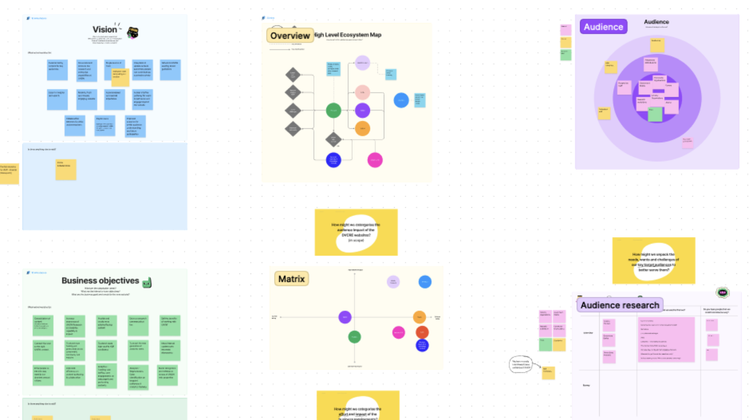
Problem
Both sites were built around the organization, not the user.
The problems looked different, but the result was the same: users could not find what they needed.
Client 01
UNSW — University of New South Wales
Eight research centres operated independently, creating fragmented navigation.
8 organisationsOrg-first IAStakeholder alignmentWorkshop-led
Client 02
Curtin University
Organic growth created unclear labels, duplicated content, and broken pathways.
Content auditSitemap auditTreejack testingCard sorting

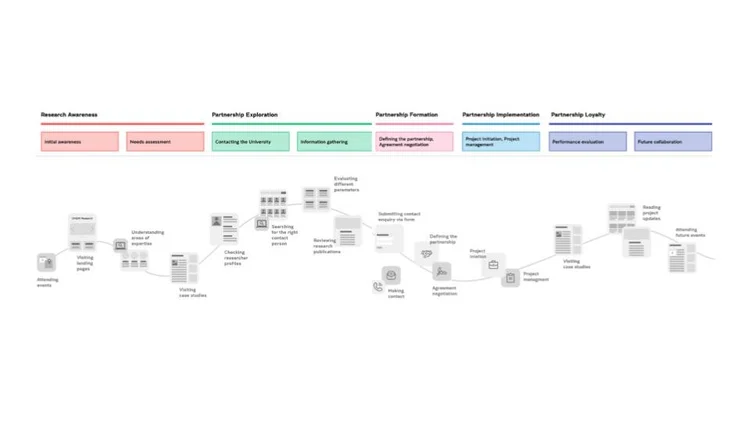
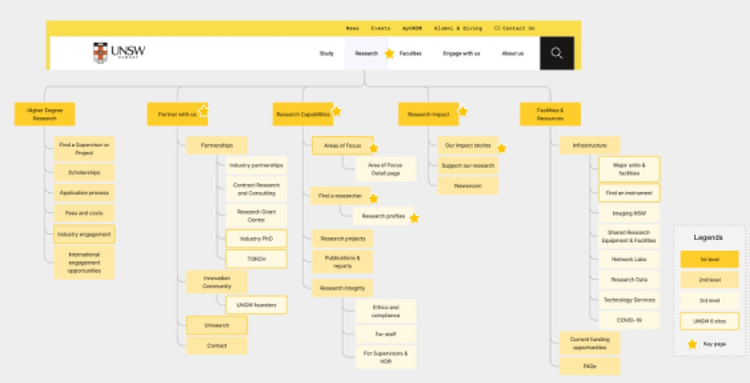
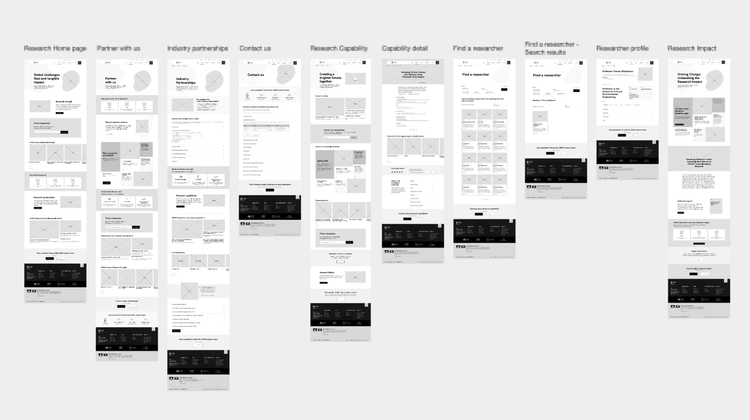
University of New South Wales
Unified 8 research-centre structures into one user-goal-based IA.

Curtin University
Organic growth had created structural chaos. A research-led audit and testing process rebuilt the IA from user evidence.
01
Sitemap & content audit
Mapped every page and content node to identify orphaned content, overlaps, and structural gaps.
Full sitemap
Content inventory
Gap analysis
02
Card sorting
Ran open card sorts to reveal how users naturally grouped and labelled content.
Open card sort
Mental model mapping
Label analysis
03
Treejack testing
Used Treejack testing to measure success rate, directness, and first-click accuracy.
Task success rate
Directness score
First-click analysis
04
Sitemap redesign & nav design
Restructured the sitemap around validated user language and scalable navigation patterns.
Restructured IA
Nav label system
Page templates
Two IA options.One validation plan.
Both options used the same research evidence.
The difference was how much structure to preserve versus how much to rebuild.
IA Option A · Low-risk evolution
Confidence through Clarity
Keep the familiar structure, sharpen meaning and intent.
Key IA Pillars
01Study · Student life
02About
03Engage
04Connect / Apply
Why it works
Keeps the existing About / Study / Engage mental model, using card-sort groupings to reorganize only the substructure beneath it.
IA Option B · Intent-centered reorganization
Confidence through Exploration
Regroup by user intent, not institutional structure.
Key IA Pillars
01Explore Your Future
02Experience Curtin
03Partner & Collaborate
04Why Curtin
05Connect / Apply
Why it works
Answers "what can I do here, and how do I get there?" directly — covering partners, industry, and researchers, not just students.
Validation design — Tree Test (Treejack), fully designed
Core content findability
Label comprehension
Structural improvement points
19 hypotheses across 4 key areas: Study, Life at Curtin, About, and Engage.
Tested with domestic and international prospective students, current students, and stakeholders.
3×
Key feature usage efficiency after UNSW redesign.
8 → 1
Org-driven IA structures unified into one user-centered system.
↑
Curtin navigation findability tested with users.