A 360° robotic companion
for wheelchair users.
metrics
secured
When the body cannot move, interaction must adapt
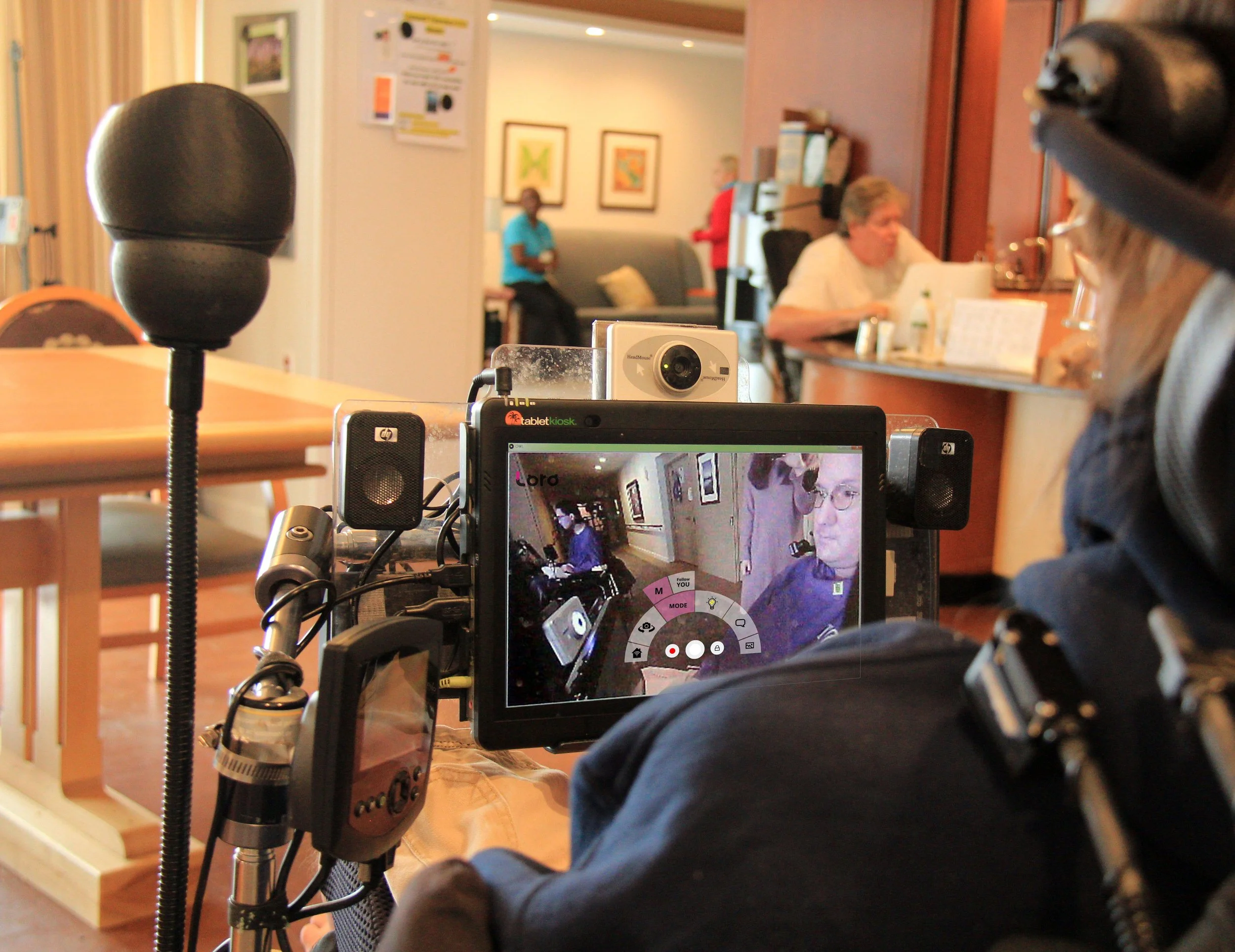
(image) In-home user research, Boston, 2019.
We visited 30+ users in bedrooms, living rooms, and ALS residences to observe how physical limitations shaped everyday interaction
| Condition | Motor Profile | Speech | Primary Input Used | N (Tested) |
|---|---|---|---|---|
| Amyotrophic Lateral Sclerosis (ALS) | Progressive full-body paralysis | Dysarthria / anarthria | Eye-tracking, head-mouse | 30+ |
| Multiple Sclerosis (MS) | Variable, often partial paralysis | Dysarthria / anarthria | Touch, joystick | 8 |
| Spinal Cord Injury (SCI) | Paralysis below injury site | Largely normal | Voice, joystick, head control | 7 |
| Cerebral Palsy (CP) | Spasticity, limited speech | Limited | Eye-tracking, switch | 6 |
| Muscular Dystrophy (MD) | Progressive muscle weakness | Limited | Joystick, touch | 5 |
| Geriatric wheelchair users | Sensory + physical combined | Largely normal | Touch, voice | 4+ |
"We are forced into dependency when we are perfectly capable of independence given the opportunity."
— Margaret L., ALS user · In-home interview, Boston 2019
Why Loro had to be wheelchair-mounted
| Alternative reviewed | Potential upside | Reason for exclusion |
|---|---|---|
| Smartphone app alone | Fastest to build | Required hand use or head movement |
| Tablet mount, no camera | Familiar AAC setup | Did not solve limited vision |
| Social robot (Jibo / Kuri-type) | Socially familiar form | Separated from the user’s wheelchair |
| Action camera | Strong 360° hardware | No AI, control, or conversation support |
Four-criteria decision rule
The form had to meet 4 conditions
No existing product met all four conditions - That gap became the starting point for Loro.
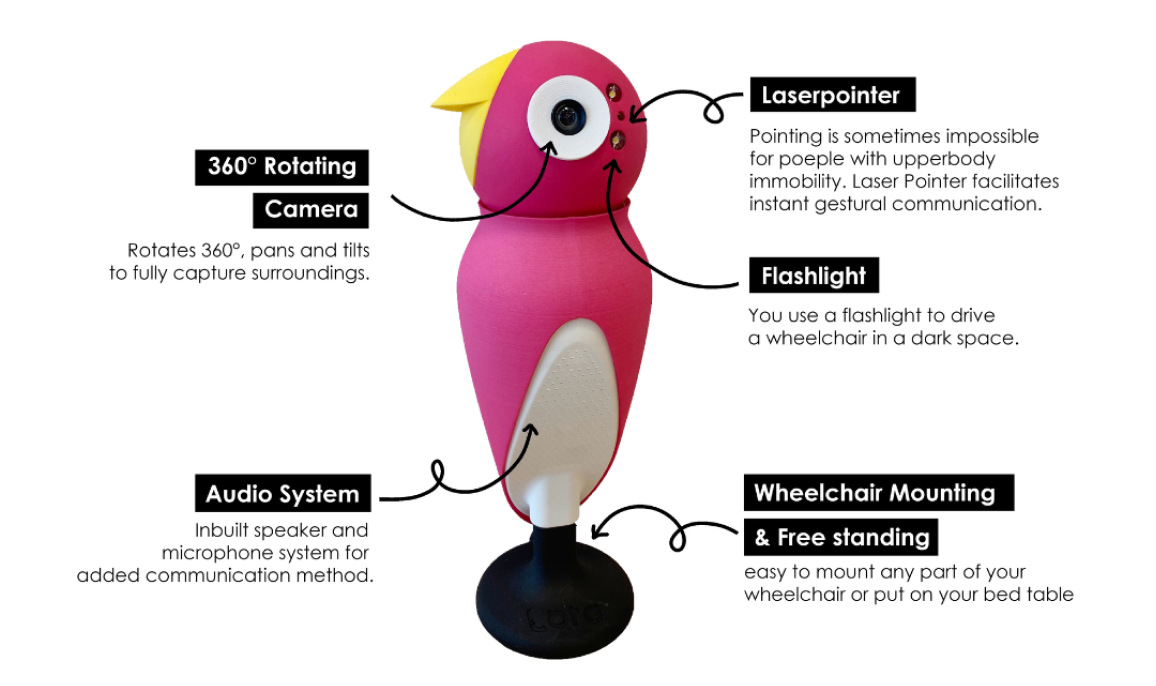
A camera that sees socially.
360° rotation alone was not enough
We added recognition, tracking, and accessible controls so users could understand who was nearby and respond without moving their head.
Face Recognition + Social Cue
Displayed a familiar person’s name and basic facial cue
so users could understand who was approaching
Eye-Gaze Radial UI
Grouped key modes within 60°
to reduce cursor travel and dwell-time errors
| Layer | Role | HRI insight |
|---|---|---|
| Rotation control | Control the camera through gaze, voice, or radial menu | Expands vision beyond neck mobility |
| Face recognition + name overlay | Recognize familiar people and show their names | Restores social awareness |
| Follow-mode tracking | Track a selected person as they move | Supports natural conversation presense. |
"When he went to a bar with friends, he was able to use Loro to see around him. He found Loro most useful in everyday tasks that brought light to what he could not see before."
— John, ALS user, age 50 · 10-day in-home test, 2019
One robot, five ways in
Different users had different ways to control the system.
Any input could trigger the same core functions.
Input Options
Eye gaze · Head mouse · Switch · Voice · Touch
Control the Room
Loro extended the same input model to smart home actions
Point Instead of Typing
Users could point at objects when typing was too slow
"Can I have some water?"
not word by word
one gaze-click away
"The first thing to bring artificial intelligence that is accessible to the disabled. Loro is a game-changer."
— Steve Saling, Co-founder ALS Residence Initiative · Advisor
Four prototypes one expanding user group
Each prototype was shaped by the users before it.
With every iteration, Loro served a wider range of mobility conditions.
VHA Pilot
6-week field pilot with ALS, MS, and SCI wheelchair users
User story · Gustavo, age 18, Chile
Gustavo has cerebral palsy, limiting his speech and voluntary movement. Before Lulu, he communicated with his family through eye-blink signals.
and joins a family conversation
From ALS hackathon to CES 2020
Field Validation
Tested with wheelchair users, ALS patients, and veterans
in real mobility contexts.
Global Recognition
Featured in PN Magazine and TechCrunch Disrupt Berlin 2018 semi-finalist